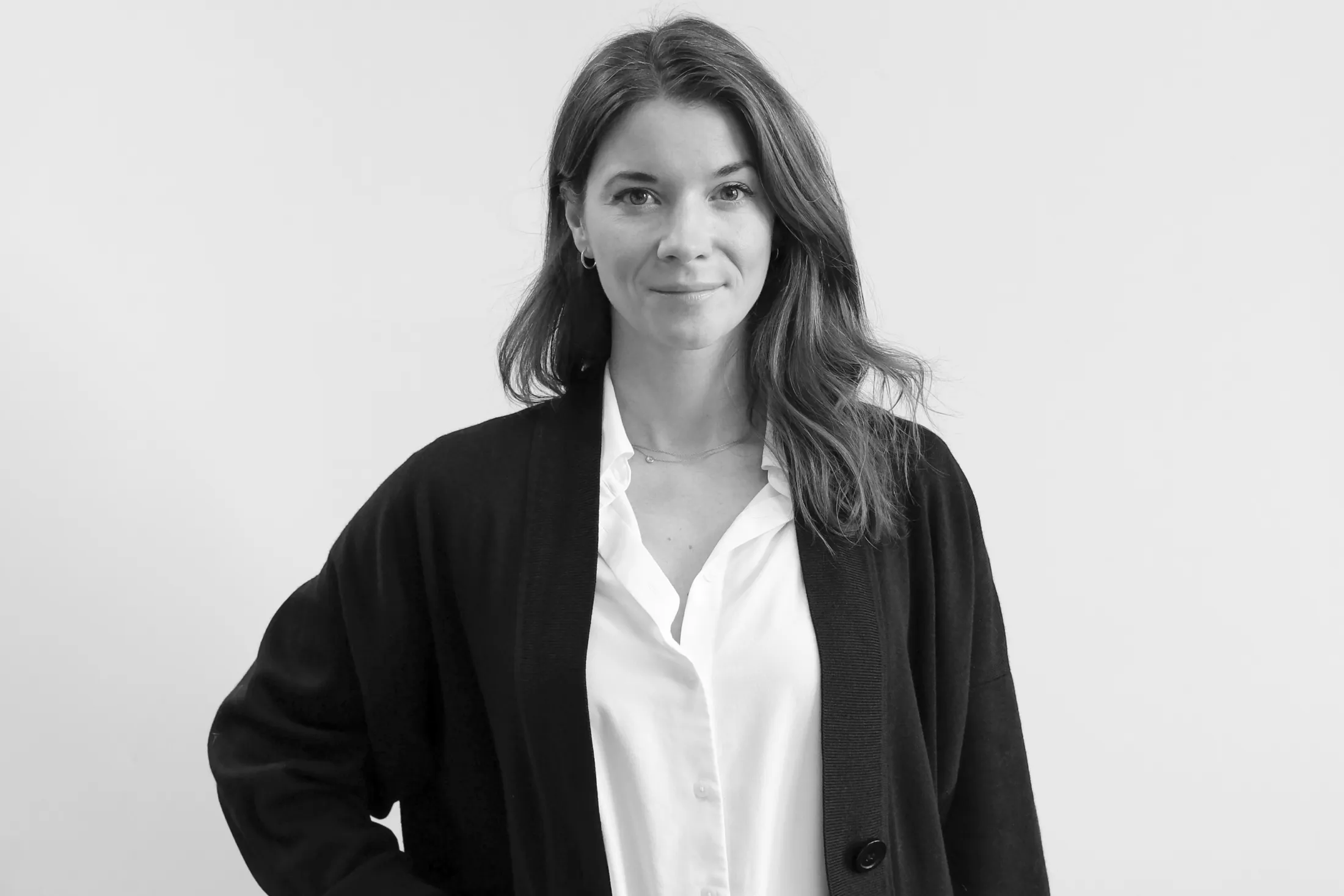
This week, meet Marie-Eve de Chantal.
Architect and Architectural Design Director at our Montreal office, Marie-Eve embodies a perfect balance between creativity and precision. She approaches each project as a way to translate an idea into space with clarity, intention, and coherence. Her journey, enriched by several years spent in Asia, has deeply influenced her way of designing: open, intuitive, and grounded in context.
Throughout the years, Marie-Eve has stood out for her ability to bring strong ideas to life while guiding teams through the creative process. For her, architecture is a continuous dialogue between imagination and pragmatism, between concept and realization.
In this article, she shares her vision of the profession, the experiences that have shaped her, and what continues to inspire her day after day.
Q. At what point did you realize you wanted to become an architect? Was there an event or experience that influenced your choice?
M-E.C. “I wouldn’t say there was a specific moment or defining event, but rather a mix of several interests that naturally led me toward architecture. I’ve always been drawn to art, history, and travel — fields that nurtured my sensitivity to space, culture, and aesthetics. At the same time, I’ve always had a pragmatic side, with an interest in science, so I was looking for something that could combine creativity with a certain logic. Architecture seemed to strike the right balance between all of that.”
Q. If you had to choose three words to describe yourself, what would they be?
M-E.C. “I’d say: creative, pragmatic, and insightful. Creative, because I love to imagine, design, and draw inspiration. Pragmatic, because I focus on what’s essential, manage priorities, and make sure things move forward in a concrete way. And insightful, because I have a good sense of analysis and can read between the lines, which helps me anticipate challenges and find solutions.”
Q. Can you tell us more about your background and what led you to your current role at LemayMichaud?
M-E.C. “I began my career in Asia. At the end of my studies, I just wanted to work there for a few months… and I ended up staying for several years. I had the opportunity to work for a Swiss firm that focused heavily on competitions — we hardly ever started a project without first building a model. This approach, very much centered on experimentation and precision, deeply shaped my thinking as an architect. When I came back and joined LemayMichaud, I quickly took on the role of Design Lead. Over the years and through various projects, I grew into my current position as Architectural Design Director.”
Q. Can you tell us about a project you worked on that left a strong impression on you?
M-E.C. “I’d say the Strøm Spa in Québec is definitely the project that marked me the most. It was a complex project, both technically and conceptually, but what truly made it unique was the clarity of the guiding vision that we managed to maintain from start to finish.
The vision was developed closely with the clients and then carried collectively by all the professionals involved. This shared foundation allowed us to guide every design decision coherently, from the very beginning through to completion.”
Q. What is your favorite aspect of your role as an architect, and as Architectural Design Director at the Montreal office?
M-E.C. “What I love most about being an architect is seeing projects come to life. Architecture is the art of building, so there’s nothing more rewarding than seeing a building you designed being realized and taking shape in the real world.
And as Architectural Design Director, what I particularly enjoy is guiding teams through the creative process and highlighting everyone’s strengths so that together, we can create the best possible project.”
Q. Which part of the project development process do you enjoy the most, and what draws you to it?
M-E.C. “Given my role, it would be hard not to say that the concept phase is the one that excites me most. It’s at this stage that the first ideas take shape and set the tone for the entire project.
That said, architecture doesn’t stop there. I’ve had the chance to be involved in all stages of a project, and I’m convinced that a designer is stronger when they also understand the constructive aspects of realization. That knowledge allows you to better anticipate challenges and deliver a truly successful project.”
Q. What recent innovations or trends in architecture particularly resonate with you?
M-E.C. “Our profession constantly pushes us to stay up to date on innovations — whether in technology, materials, or sustainable development. But what speaks to me the most are still the classic tools: pencil, tracing paper, model…simple means that, for me, remain the most effective for thinking through a project.”
Q. Is there an aspect of architecture, or of being an architect, that you feel is underrated but essential?
M-E.C. “I think listening and analysis are aspects that are often underestimated but essential in our profession. Listening to clients, users, teams, the constraints of the site or program…and interpreting them accurately is what allows us to design a coherent, meaningful project.”
Q. Has a particular trip, encounter, or experience influenced the way you design or approach projects?
M-E.C. “Living abroad, as well as traveling to different places, has influenced both the way I am and the way I approach design. These experiences taught me to think outside the box, to stay curious and open-minded, and to adapt quickly to changing contexts.”
Q. What advice would you give to an aspiring architect?
M-E.C. “My advice would be to stay curious and open to all kinds of experiences. Architecture is a field that requires creativity, discipline, and patience — but above all, it’s a path of continuous learning. Don’t hesitate to step out of your comfort zone, to travel, and to learn from every project. It’s by combining these experiences that you’ll develop your own vision and expertise.”
Quick Q&A
Q. Développer ou créer?
Create.
Q. Dreamer or realist?
Both! It’s that duality between dreaming and realism that best describes me.
Q. What gets you out of bed in the morning?
I have to admit, I’m not much of a morning person. If I could stay in bed longer, I would!
Q. Your favorite part of the job?
The days when we laugh a lot!
Q. Do you have a guiding philosophy?
Recently, someone told me (Thank you M-C): To create is to choose. Having confidence in your creative choices, even the most intuitive ones, is what makes all the difference.
Q. Black and white or color?
Anyone who knows me will say black and white…but mostly black!
Q. Mies van der Rohe or Frank Gehry?
Mies, without hesitation.
Q. Is there a project or work you wish you could have designed yourself?
I deeply admire the work of David Chipperfield. The further you go in this profession, the more you realize how difficult true simplicity and mastery are to achieve.